
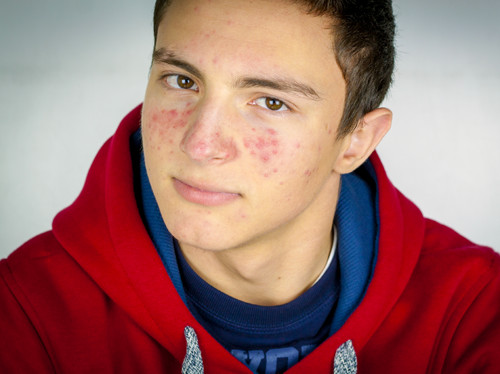
 Acne is the term for plugged pores (blackheads and whiteheads), pustules, pink bumps, and even deeper lumps (cysts or nodules) that occur on the face, neck, chest, back, shoulders and even the upper arms. Acne affects most teenagers, some children, and many adults. While not a life threatening condition, acne can be upsetting and disfiguring. When severe, acne can lead to serious and permanent scarring. Even less severe cases can lead to scarring.
Types of Acne
- Acne lesions range in severity from comedones (blackheads and whiteheads) to nodules and cysts. Here are brief definitions of acne lesions:
- Comedo (plural comedones) – A comedo is a sebaceous follicle plugged with sebum, dead cells from inside the sebaceous follicle, tiny hairs, and sometimes bacteria. When a comedo is open, it is commonly called a blackhead because the surface of the plug in the follicle has a blackish appearance. A closed comedo is commonly called a whitehead; its appearance is that of a skin-colored or slightly inflamed “bump” in the skin. Neither blackheads nor whiteheads should be squeezed or picked open, unless extracted by a dermatologist under sterile conditions. Tissue injured by squeezing or picking can become infected by staphylococci, streptococci and other skin bacteria.
- Papule – A papule is defined as a small solid lesion slightly elevated above the surface of the skin. A papule is caused by localized cellular reaction to the process of acne.
- Pustule – a yellow soft lesion containing pus that typically consists of a mixture of white blood cells, dead skin cells, and bacteria.
- Nodule – a solid, dome-shaped lesion. Many patients describe nodules as “blind pimples” which never seem to come to a “head”.
- Unlike a papule, a nodule is characterized by inflammation, extends into deeper layers of the skin and may cause tissue destruction that would result in scarring. A nodule may be very painful.
- Cyst – A cyst is a sac-like lesion containing liquid or semi-liquid material consisting of white blood cells, dead cells, and bacteria. It is larger than a pustule, may be severely inflamed, extends into deeper layers of the skin, may be very painful, and can result in scarring.
The good news is:
We will assess the lesions on your face to determine the type of acne which you have—which will then determine our plan of care. For example, retinoids are imperative when treating someone with numerous comedones but not always as helpful when treating pustules.
Remember, resolution takes time.
Treatments that promise fast results often capture the attention of acne sufferers hoping for quick resolution. However, the fact remains that acne does not clear overnight. The time a follicle becomes plugged to the time it becomes a visible lesion is 6 weeks—thus, any medication used today is treating/preventing acne 6 weeks from now. On average, 8 weeks are needed to see initial improvement. Once acne significantly improves or clears, continued treatment is needed to keep acne from re-appearing. If acne does not improve in 12 weeks, treatment may need to be adjusted as not every acne treatment clears every case of acne. Dermatologists recommend that acne be treated early to maximize effectiveness as well as help prevent scarring.